
American Terrorists
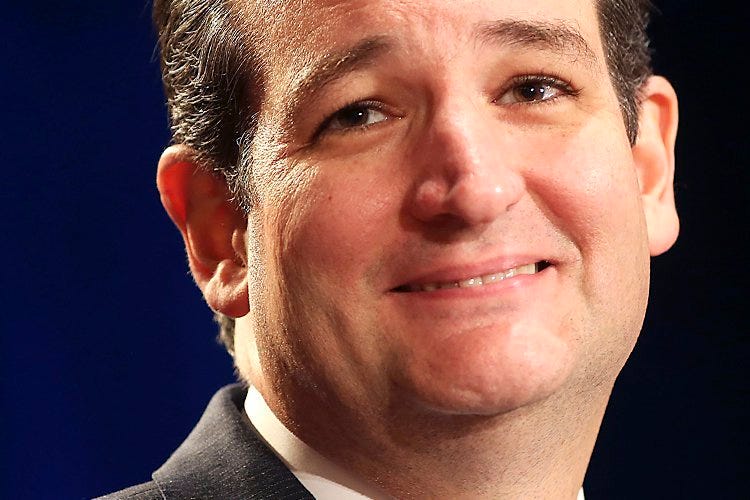
On July 18th, Senators Bill Cassidy (R-LA) and Ted Cruz (R-Abandoned Soup Factory) introduced S.R. 279: “Calling for the designation of Antifa as a domestic terrorist organization.” The impetus for this resolution appears to have been the events that transpired at a march organized by the right-wing extremist group The Proud Boys on June 29th in Portland.
Members of Antifa – some of whom have been viciously attacked by Proud Boys in the past – showed up to demonstrate against the march, and before long, fighting broke out. At some point during the fracas, right-wing commentator Andy Ngo was punched, yelled at, and had a milkshake thrown on him by Antifa. Ngo filmed the assault as it took place and posted the video on Twitter.
Before you start feeling bad for Andy Ngo, it’s worth noting that he has built his career primarily on goading Antifa counterprotestors while filming them, then using the video of their reactions – usually limited to exasperated yelling – as proof that the left are deranged, intolerant monsters. Considering the frequency with which Ngo has antagonized groups of pissed-off counterprotestors, it was bound to happen sooner or later. Ngo has since claimed that the milkshake was mixed with concrete (it wasn’t) and that the attack left him with a brain injury, a self-diagnosis apparently confirmed by his inability to hold onto some fruit:

Whether or not Ngo actually wanted to get punched is up for debate, but something tells me he’s not complaining about the results: the day of the attack, a GoFundMe called “Protect Andy Ngo” was started. Within 24 hours, the fundraiser met its goal of $50,000; by the time the campaign ended, donations totaled nearly $195,000. And as a cherry on top, the United States government is now debating whether to classify his ideological opponents as terrorists. Not a bad return on investment, all things considered.
Depending on how much you know about Antifa, Cruz’s resolution can be viewed either as good, common-sense legislation to protect conservatives from a roving gang of thugs, or as a harbinger of things to come. There are two basic reasons why someone might believe the former: either they’re a conservative (or, worse, a centrist), or their only exposure to Antifa has been through mainstream media coverage. Similarly, there are two reasons why someone might believe the latter: either they support Antifa, or because Ted Cruz is so profoundly execrable that opposing him is almost reflexive.
Before we can tackle the question of whether or not Antifa is a terrorist organization, we first need a quick primer on Antifa and its history.
The anti-fascist movement has roots in pre-WWII Italy, but it did not rise to prominence until sometime after the end of World War II and the fall of the Third Reich, when the overarching goal was to oppose the last vestiges of fascism still present in Germany at the time. The tactics of Antifa (short for “Antifaschistische Aktion”) were elegant in their simplicity; in his examination of the movement for Jacobin, Loren Balhorn describes Antifa as “shorthand for decentralized, militant street activism associated with its own aesthetic and subculture.”
Over the years, the movement evolved. The modern variant of Antifa in Europe is not as policy-focused as its forebears; rather, it exists primarily to serve as a counterbalance to far-right and nationalist political parties, many of which gained a foothold in Europe in the 1980s. But fascism in Europe is a different beast from fascism in America. While the United States does have its own history of flirtation with fascism — this Washington Post article notes the support fascist politics received from prominent Americans like Henry Ford and Charles Lindbergh in the 1930s — it has never been led by an overtly fascist government.
American anti-fascism, therefore, is more a cultural and social movement than it is an explicitly political one. In his book Antifa: The Anti-Fascist Handbook, writer Mark Bray describes Antifa’s ideology thusly:
At the heart of the anti-fascist outlook is a rejection of the classical liberal phrase incorrectly ascribed to Voltaire that “I disapprove of what you say, but I will defend to the death your right to say it…[A]nti-fascism is an illiberal politics of social revolutionism applied to fighting the Far Right, not only literal fascists.
Broadly speaking, Antifa considers itself the archrival of white supremacy, neo-Nazism, and bigotry, and Antifa activists believe they have a responsibility to confront and oppose public expressions of those ideologies wherever possible. The tactic most commonly associated with Antifa is the “black bloc,” where masked members engage in fights, vandalism, and property destruction. When employed as part of a larger protest, these tactics draw attention to the black blockers, thereby allowing the other members of the group to safely protest without fear of retaliation. And on their own, black bloc tactics can also be used to send a message to Antifa’s opponents.
But while Antifa is known for fighting, physical confrontation is just one of the many direct-action tactics the group employs. Antifa activists have also preemptively occupied sites where fascist events are scheduled to take place, infiltrated fascist groups and disrupted them from within, prevented the distribution of fascist materials, and so on. The general consensus is that while physical force should not be the go-to response to fascism and racism, it is sometimes needed in order to prevent further violence. As an activist named “Murray” told Bray:
You fight them by writing letters and making phone calls so you don’t have to fight them with fists. You fight them with fists so you don’t have to fight them with knives. You fight them with knives so you don’t have to fight them with guns. You fight them with guns so you don’t have to fight them with tanks.
Two years ago, white supremacists clashed with counterprotesters – including Antifa – at the “Unite The Right” rally in Charlottesville. After the melee, The Atlantic (of course) published a piece by Peter Beinart called “The Rise of the Violent Left”; in it, Beinart argues that “[t]he people preventing Republicans from safely assembling on the streets…may consider themselves fierce opponents of the authoritarianism growing on the American right. In truth, however, they are its unlikeliest allies.” Beinart’s contention that Antifa are “preventing Republicans from safely assembling” is inaccurate – Antifa are preventing neo-Nazis, white supremacists and fascists from safely assembling. (The fact that Beinart felt comfortable enough using those terms interchangeably doesn’t say much for Republicans.)
Beinart’s argument – and the countless others that have come before and since – is predicated on the assumption that tolerance of others is a foundational component of American society. Cruz’s resolution says as much, contending that “Antifa represents opposition to the democratic ideals of peaceful assembly and free speech for all.” But as Herbert Marcuse argues in his essay “Repressive Tolerance”:
[T]olerance is an end in itself only when it is truly universal, practiced by the rulers as well as by the ruled, by the lords as well as by the peasants, by the sheriffs as well as by their victims. […] As long as these conditions do not prevail, the conditions of tolerance are “loaded”: they are determined and defined by the institutionalized inequality…of society.
Tolerance means acknowledging that the other party’s viewpoint is valid. It also requires compromise, but compromise requires the existence of a common ground. Where Antifa and their neo-Nazi and white supremacist foes are concerned, however, there is no common ground to be shared. Neo-Nazis and white supremacists will accept nothing less than a pure white ethnostate or, failing that, a society in which whites are the ruling class both now and in perpetuity. Any social or political development that does not serve that purpose is wrong and must be strongly opposed; often as not, they do so with violence. According to the Southern Poverty Law Center, in the first ten days following Trump’s election, there were 867 instances of harassment, intimidation and violence; of those instances, 844 were motivated by the victim’s race, ethnicity, sexual orientation, or religion. Whether or not they routinely engage in overt acts of violence, the threat of neo-Nazi violence still remains; after all, an army that doesn’t fight is still an army.
Should we be tolerant of other beliefs and perspectives wherever possible? Of course. But if tolerance is based on the existence of some common ground or a shared belief, then tolerating neo-Nazis is to concede that they have a point. By asserting that neo-Nazis should be allowed to spew hatred and vitriol in the faces of the people most threatened by their existence without any pushback, Ted Cruz is not protecting the “democratic ideals of peaceful assembly and free speech for all,” because it’s a zero-sum game. White supremacy can only be achieved by silencing the voices of nonwhite people, either through intimidation or force; protecting one means sacrificing the other.
Antifa activists refuse to make that sacrifice. Does that make them terrorists?
Terrorism is a strange thing.
It is nearly impossible to define – whether or not a group’s actions qualify as acts of terrorism is entirely in the eye of the beholder. Most often, who is or is not a terrorist is defined by those in power, which is paradoxical in itself. We call Samuel Adams a revolutionary because America won the war; if we hadn’t, he would be a terrorist. Soldiers in the Provisional IRA were terrorists condemned to indefinite imprisonment…until the Good Friday Agreement was signed, at which point nearly all of them were released and allowed to go on with their lives. A terrorist is only a terrorist until the balance of power shifts in their favor.
Although there is no universally-accepted definition of terrorism, it is often broadly interpreted to mean “any act that causes and sustains terror”; indeed, Cruz’s resolution leans heavily on this definition. The FBI defines terrorism as “Perpetrated by individuals and/or groups inspired by or associated with movements that espouse extremist ideologies of a political, religious, social, racial, or environmental nature.” These definitions make for a tidy shorthand, but they’re nonetheless incomplete: neo-Nazi Andrew Anglin, founder of the Daily Stormer, was recently ordered to pay $14 million for inciting his site’s readers to harass and threaten a Jewish woman en masse. According to the above definitions, his actions were a clear-cut example of terrorism, yet to my knowledge, nobody branded Anglin a domestic terrorist.
Why not? Because even though it’s not explicitly required to fulfill either of the above definitions, the line of demarcation between harassment and terrorism is violence; “sticks and stones,” and all that. (By that metric, the Ku Klux Klan’s cross burnings are just a fire code violation.)
The FBI’s and Ted Cruz’s definitions of terrorism also don’t take into account power dynamics: We typically think of terrorism as a minority taking violent action against the majority, but only because that’s how the majority (which holds the power) defines it. Yet when those in power create fear in a population and target an entire group – even when they use violence to do it – we call that something else. Black Americans live in fear of death by cop: that’s just “good policing.” Children in Pakistan are terrified of blue, cloudless skies because that’s when American drones swoop in and bomb entire villages: that’s “defending freedom.” Parks are empty on beautiful summer days because members of the Hispanic community are terrified that ICE agents will arrest and detain them, even though they’re in the United States legally: “strong border enforcement.” These are violent, politically-motivated acts by formal organizations that provoke fear and dread in members of the targeted groups, but the organizations perpetrating these acts are part of the prevailing power structure that gets to define what is terrorism and what is not.
And atop that power structure is Donald Trump, a man who, it has been argued, is engaging in stochastic terrorism: “The use of mass communications to incite random actors to carry out violent or terrorist acts that are statistically predictable but individually unpredictable.” (See: Crusius; Parkland shooter Nikolas Cruz; Cesar Sayoc Junior, an avid Trump supporter who mailed pipe bombs to prominent Democrats and Trump’s critics; and so on.) An FBI agent told Mother Jones last year that Trump’s rhetoric “has empowered white supremacist groups to be much more public. It’s very dangerous because these people who have a history of violence now feel they have state sanction to commit violence.” But that’s an argument for another day.
Writer and social activist Achin Vanaik has developed a lengthier, but more useful, definition of terrorism:
[Terrorism] is the calculated or premeditated use or threat of use of violence against an individual, group or larger collectivity in such a manner that the target is rendered physically defenseless against that attack or against the effects of that violence. [The violence] is harnessed to some political intent or purpose and carries a political meaning.
The defenselessness can be the result of a) surprise outside of a battle- or war-zone; b) the nature of the target chosen; e.g., its civilian status; c) the nature of the weapons used; d) enormous disproportion in the violence exercised between the two sides even within a battle- or war-zone, i.e., a gross violation of the principle of minimal or reasonable force.
Let’s put it to the test.
Last Saturday, 21-year-old Patrick Crusius drove 10 hours from his home in Allen, TX to El Paso, a predominantly Hispanic city on the U.S.-Mexico border. (I know journalistically I’m supposed to say things like “allegedly” and “suspected,” but there’s footage of him carrying out the shooting, so I’m not going to bother.) Upon arriving at his destination, Crusius allegedly – which I only use here because there’s still some question as to who’s responsible – uploaded a 2,300-word manifesto entitled “The Inconvenient Truth” to 8chan, a message board that also serves as the worst place on the internet. Among other things, the manifesto inveighed against a “Hispanic invasion of Texas,” warned that whites were being replaced by foreigners, and accused Democrats of using “open borders” and “free healthcare for illegals” to “turn Texas blue.” After (allegedly) posting the manifesto, Crusius walked into the El Paso Walmart and opened fire. Twenty-two people were killed; dozens more were injured, including a two-month-old infant who sustained broken fingers when his parents fell on him to shield him from gunfire. Both parents were killed.
The shooting was premeditated and politically-motivated, the targets were 1) defenseless civilians who were 2) outside of a war zone, and there was enormous disproportion in the violence exercised between the two sides. Vanaik’s definition, then, seems to cover all the necessary bases, and authorities agree: the US Attorney for the Western District of Texas has announced that Crusius will face domestic terrorism charges and the death penalty.
Now, let’s apply Vanaik’s definition to Antifa, using one of the examples cited by Cruz in his resolution: the Berkeley riots. It is unclear which specific instance Cruz is referring to in his resolution (there are multiple), but let’s assume he means the one that took place in late August 2017. These particular riots resulted in the widely-shared video of unarmed right-wing activist Keith Campbell being kicked, punched, and hit with a stick by four black-clad protesters. Antifa were condemned by the left and the right for the violence, and conservatives and Trump supporters seized on the video as proof that they are indeed a persecuted minority in the United States. (How one can arrive at that conclusion when their idol is the most powerful man on the planet is beyond me, but the average Trump supporter’s thirst for claim victimhood is unslakable.)
Was the assault on Campbell an act of terrorism? A post on ItsGoingDown.org details Campbell’s long history of trolling and threatening anti-fascist activists on social media, including a doxxing campaign. In fact, moments before he was attacked, witnesses say Campbell was walking through the crowd of counterprotesters and recording people’s faces so he could upload them to social media and target anyone his audience could identify.
One could argue Campbell was taken by surprise in the moment; however, Campbell (who goes by “@KPikklefield” on Twitter) spent the weeks leading up to the Berkeley rally threatening activists on social media:
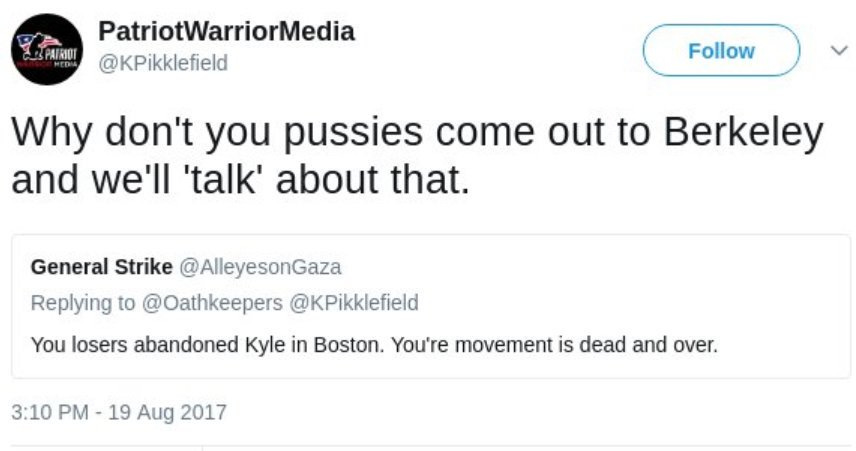
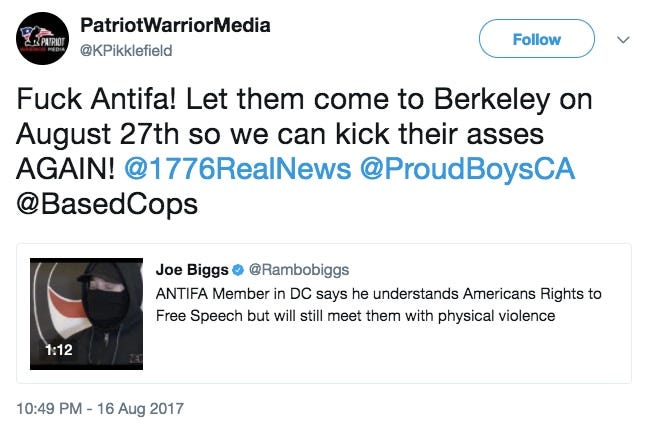
The threats Campbell made prior to the event indicate a clear understanding of what could potentially occur at the rally itself; in fact, he seems to welcome the prospect of violence. Thus, it can't be argued that he was taken by surprise, nor can it be argued that the action was taken outside of a battle-zone – Campbell himself designated the rally as such. Campbell’s assault also does not meet the standard of “enormous disproportion in the violence exercised”: he was punched and kicked and hit with a stick, yes, but that hardly qualifies as an enormous disparity. (Moreover, the attack lasted for exactly ten seconds before progressive journalist Al Letson broke it up and shielded Campbell from further harm.) No reasonable definition of terrorism, Vanaik’s or otherwise, is broad enough to include a man on the receiving end of a fraction of the violence with which he routinely threatens his ideological opponents.
None, that is, except for the one Ted Cruz is using.
Later in the bill, Cruz provides another reason for Antifa’s designation as a terror group: “Rose City Antifa, an Antifa group founded in 2007 in Portland, Oregon, explicitly rejects the authority of law enforcement officers in the United States, and Federal, State, and local governments.” This is true – Antifa activists do not engage with law enforcement, even when it is in their best interest to do so: after a mob of Proud Boys were arrested for brutally assaulting Antifa activists in New York City, the activists refused to cooperate with the investigation. If the roles were reversed, the Proud Boys would be on the Fox News talk show circuit as we speak, wailing about the terrorist left, robbing us of our right to free speech. (See: Campbell, Keith.)
Antifa activists have good reason not to talk to the Portland P.D. – a February report revealed that a PPD lieutenant had exchanged hundreds of texts with a white supremacist organizer. In any case, Ted Cruz won’t stand for this anti-government, anti-law enforcement ideology, and you have to admire his commitment to law and ord- what’s that? Ted Cruz was a vocal supporter of the anti-government, anti-law enforcement Oregon militia whose members armed themselves to the teeth, stormed a wildlife preserve and occupied it for over a month?
As the full picture of the carnage on display in El Paso was coming into focus, Texas Lieutenant Governor Dan Patrick went on Fox News. Patrick didn’t offer much detail about the shooter or his motivations for the attack, because at the time he was on television, there was little detail to be had. So Patrick used this time to focus instead on what he’d heard was the real threat to the safety of Texans: Antifa.
I just saw the last couple of days where Antifa is posting they want to come to El Paso for a 10-day siege. Clear message, Antifa: Stay out of El Paso. Stay out of Texas, basically. […] I would say to Antifa: Scratch Texas off your map and don’t come in. It is not the time or place for them to come in anytime.
Antifa does not “lay siege” to cities, of course; they’re not the Visigoths. In fact, Antifa is not a formal organization by any stretch, but rather a loose collective a local actors – in other words, Antifa are likely already in El Paso because they live there. To the extent Antifa activists do travel, it is in response to a planned gathering of fascists, neo-Nazis, or white supremacists. The source of Patrick’s information was The Daily Caller, a conservative “news” site whose Wikipedia page has an entire section devoted to the most notable times the site has published fake or misleading news stories. Unsurprisingly, The Daily Caller later updated its Antifa article to clarify that there was no evidence to support its own reporting.
(And where did The Daily Caller get its information? From Andy Ngo, last seen cashing a $195,000 check and trying in vain to hold onto his fruits. Strange coincidence, that.)
What’s most interesting is that Lt. Gov. Patrick brought up Antifa at all. There was no evidence to suggest Antifa had anything to do with the shooting, and as Antifa has never been linked – directly or indirectly – to any killing, it seems an odd place to cast a hunch. Perhaps Patrick was trying to talk about anything besides the fact that even in Texas, the oft-invoked “good guy with a gun” is always curiously absent during these mass shootings. Most likely, Patrick was attempting to draw a false equivalence between Antifa activists and mass shooters, a bit of opportunistic political maneuvering that was as hamfisted as it was grotesque.
Ted Cruz, Dan Patrick, Sean Hannity, Tucker Carlson and scores of other right-wing commentators would like you to believe that there is no functional difference between Antifa and white supremacists; Carlson, for his part, recently told his viewers that white supremacy in America is “a hoax, just like the Russia hoax […] It’s a conspiracy theory used to divide the country and keep a hold on power.” But nothing could be further from the truth.
Neo-Nazis and white supremacists commonly refer to America’s changing racial composition as “white genocide,” and some believe a “racial holy war” (or “RaHoWa”) is imminent. By framing simple demographic changes in militaristic and violent terms, the implication is clear: the only way for the white man to survive is through violence; thus, their actions – including mass murder – are proactive. Antifa, on the other hand, are strictly reactive – its raison d’être is to combat fascism. Antifa does not storm into shopping centers and churches and schools, killing everyone who looks like they might be the enemy. When Antifa deploys violence, it is against willing combatants who have made the informed decision to publicly embrace racism and fascism by participating in hate rallies. This is not a chicken-and-egg scenario; it is simple cause and effect. In order for an oppositional group or force to exist, the thing or group to which it is opposed must already be present. Without fascists, there would be no need for anti-fascists.
Cruz is using the broadest definition of “terrorism” imaginable: merely the potential existence of fear is enough to qualify Antifa as a domestic terror organization in his mind. From a legislative standpoint, a blanket condemnation is somewhat understandable – it is, I suppose, better to cast a wide net than to define the terms too narrowly and give actual terrorist organizations a loophole. But how can one reshape the meaning of terrorism to includes Antifa but not groups who pose a far greater threat to the safety of Americans? Why aren’t the Proud Boys named in this resolution? Why isn’t the Atomwaffen Division, whose stated goal is to overthrow the federal government using terror tactics and has committed 5 murders since 2015? Why isn’t the KKK? In fact, why is this…
[The Senate] calls upon the Federal Government to redouble its efforts, using all available and appropriate tools, to combat the spread of all forms of domestic terrorism, including White supremacist terrorism.
…the only time white supremacist terrorism is mentioned, even though white supremacist groups or actors are responsible for more than 670 deaths, more than 3,000 non-fatal injuries and more than 4,000 attacks from 1990 to 2012? Even though far-right extremists accounted for 73% of extremist murders in the United States from 2009 - 2018? Because no matter what oily sheen Cruz tries to put on it, this resolution is not intended to denounce terrorism. It is intended to criminalize dissent.
Antifa is a convenient foil, but the language of the resolution uses “Antifa,” “those affiliated with Antifa,” and “left-wing activists” interchangeably. Under this definition, anyone who attends a counterprotest and stands next to someone who gets into a fight with a neo-Nazi can be branded as “affiliated with Antifa”; even attending a rally where no violence occurs can be enough to justify the label of “left-wing activist.” This resolution calls for the use of state-sanctioned violence against those who pose a threat to people like Ted Cruz maintaining their grip on power.
It is unlikely this resolution will pass, not least because it is currently not possible to legally designate any group as a domestic terror organization. (The State Department handles the terror designation system, and one of their criteria is that the group must operate primarily overseas.) Any legislator with a passing understanding of the law knows this; as a former lawyer and Supreme Court clerk, Ted Cruz knows it better than most. The only reason for him to introduce a resolution that he knows is legally unenforceable is as a gesture of solidarity with white supremacists and neo-Nazis across the country, one that empowers them to continue their campaign of fear, intimidation, and violence against those most in need of protection. By focusing on Antifa – and, more broadly, the left – and only mentioning white supremacist groups in passing, this resolution legitimizes a growing sentiment on the right that Antifa are the real terrorists. As that sentiment grows, so too does the likelihood that some right-wing extremist will shoot up a local DSA meeting or counterprotest under the guise of “defending America.”
Which, I’m afraid, is the point.